Virtual Staging Cost vs Traditional Staging: What Listing Agents Pay
Compare virtual staging cost with a traditional staging invoice: NAR’s 2025 medians, how long each takes, and when a vacant listing still needs one on site.
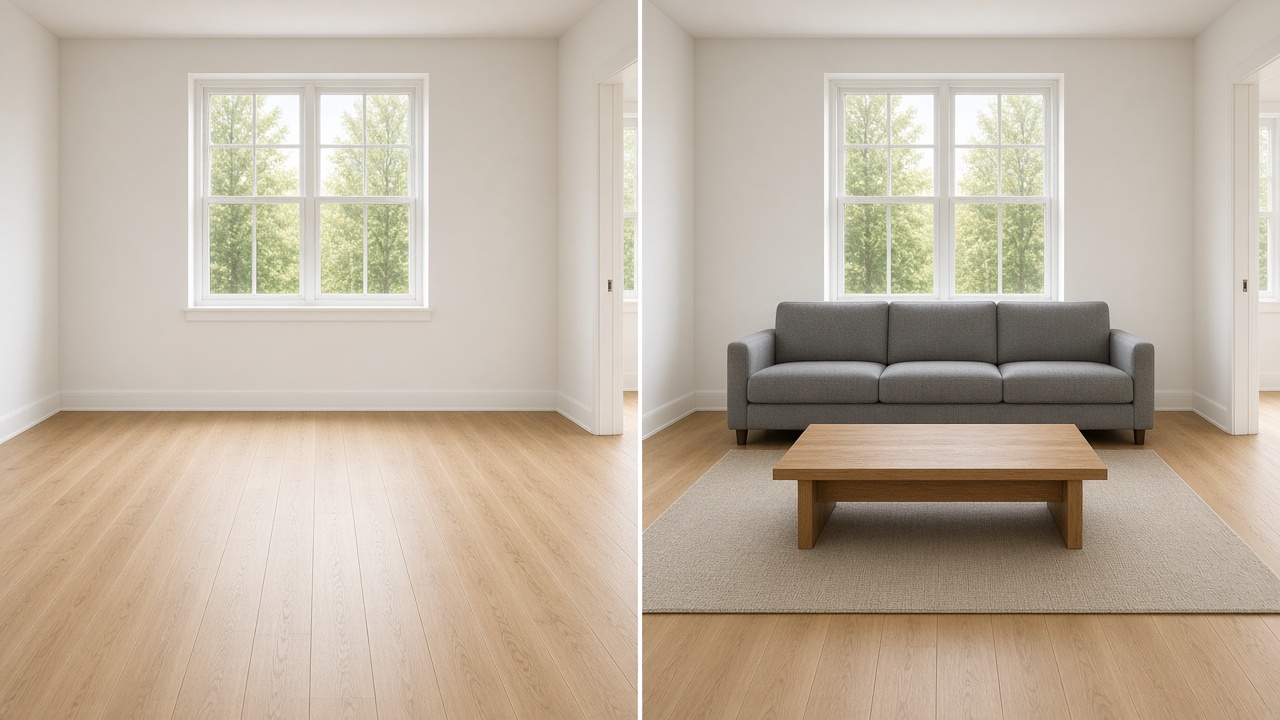
The photograph at the top is an illustration, not a listing and not a render from this site. It shows the decision in one frame: an empty living room, then that same room with a sofa, a table, and a rug added. Virtual staging cost is what you pay to make that change in the photograph. Traditional home staging is what you pay to make it in the house.
Buyers do meet the house later. The first pass is usually the photos. In the National Association of Realtors’ 2025 Profile of Home Buyers and Sellers, 46% of buyers said their first step was looking for properties on the internet, and 52% found the home they bought through an online search. Among buyers who used the internet, 81% said photos were very useful.
Who virtual staging is for, and who should still hire a stager
Virtual staging fits a vacant room that has to look furnished in the listing gallery. The input is the photo you already shot: wide, in daylight, with the architecture left alone. Furniture is added in the file. The walls, windows, and doorways are supposed to stay where they were.
Hire a stager when the buyer will decide in the room. That is the occupied house, the open house that depends on how the space feels, and the listing where the furniture has to be real because people will sit on it. NAR’s 2025 Profile of Home Staging asked agents about staging in general, not only the virtual kind. Buyers’ agents said the living room mattered most (37%), then the primary bedroom (34%) and the kitchen (23%).
A vacant listing can still be the wrong job for software. If the photo already contains the seller’s sofa, laying new furniture around it does not clear the room. Shoot it empty, or leave that frame out. And if the goal is to hide a crack, a stain, or a missing fixture, neither kind of staging is the right tool. The photograph has to remain a photograph of that house.
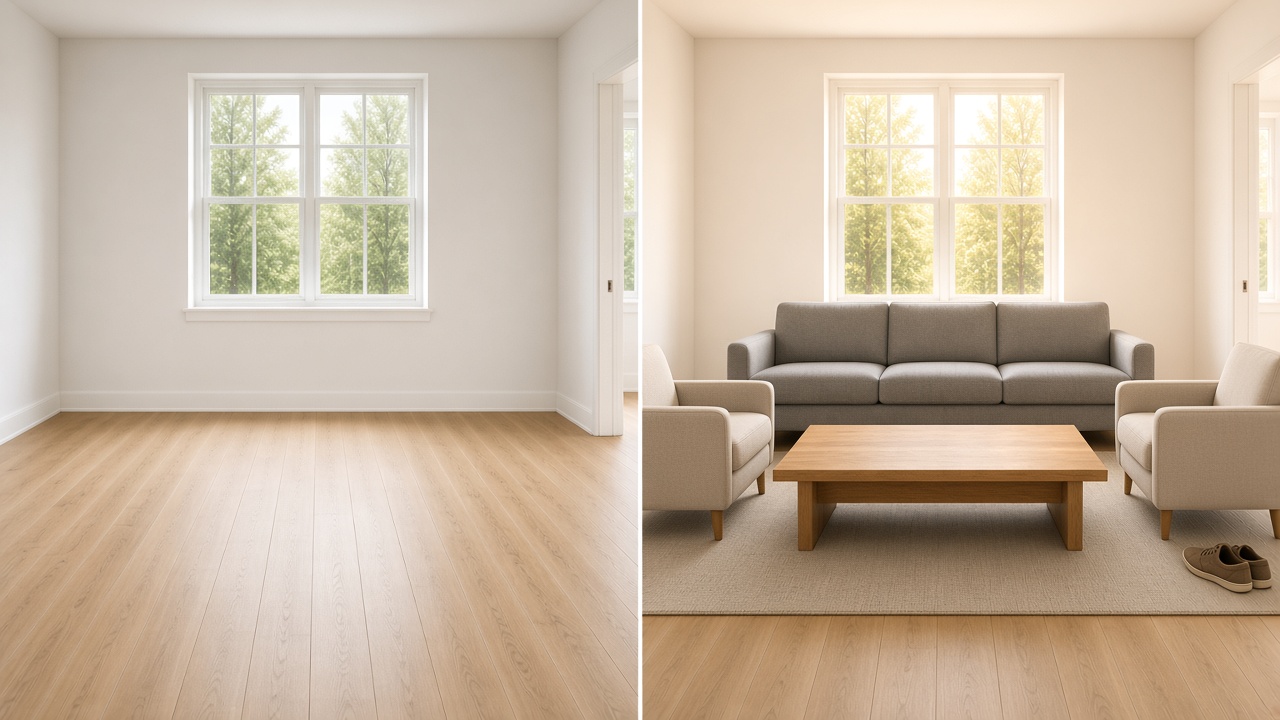
Illustration only. The empty side is the photograph. The right side is a room a buyer can sit in, which is when you still hire a stager.
How long each option takes before the listing goes live
A traditional staging invoice starts the clock before the photo exists. Someone books the stager, furniture comes in, the room is arranged, and then the photographer shoots it. The listing waits on that sequence. NAR’s 2025 staging survey reports what agents paid, not how many days the job took, so this article does not invent a national turnaround.
Virtual staging for real estate starts from photos you already have. The wait is the time to furnish the image and check it, then to upload it with whatever label your MLS requires. A studio that does the work by hand may still quote a day or two. Virtual staging on this site starts from the photo you uploaded and can come back in about a minute. Either way, you are not waiting on a truck.
Buyers meet the photos in the MLS feed, not in your camera roll. The cover image is the one search results show, so a furnished cover still has to be labeled as furnished if that is what it is.
What buyers see, and what the photo cannot promise
Buyers’ agents in the same NAR survey said photos were highly important to their clients (73%). A majority, 83%, said staging made it easier for a buyer to picture the property as a future home. That is a reason to furnish the picture. It is not a promise that the home will sell for more, or sell faster, by a fixed percent.
Read the offer figures the same way. Twenty-nine percent of sellers’ agents said staging was followed by a 1% to 10% increase in the dollar value offered. Seventeen percent of buyers’ agents put a smaller band on it, 1% to 5%, compared with similar homes that were not staged. Almost half of sellers’ agents (49%) said staging reduced time on market. Those are shares of agents reporting an effect. They are not a finding that every staged home earns a premium.
Virtual staging has a further limit the survey hints at. Among sellers’ agents, 34% said virtual staging was less important to their clients than other listing media, and 24% said it was equally important. The gallery can help someone imagine the room. It cannot hand them a sofa that is not there when they walk in. Say so at the showing. If your MLS asks for the original empty photo next to the furnished one, publish both.
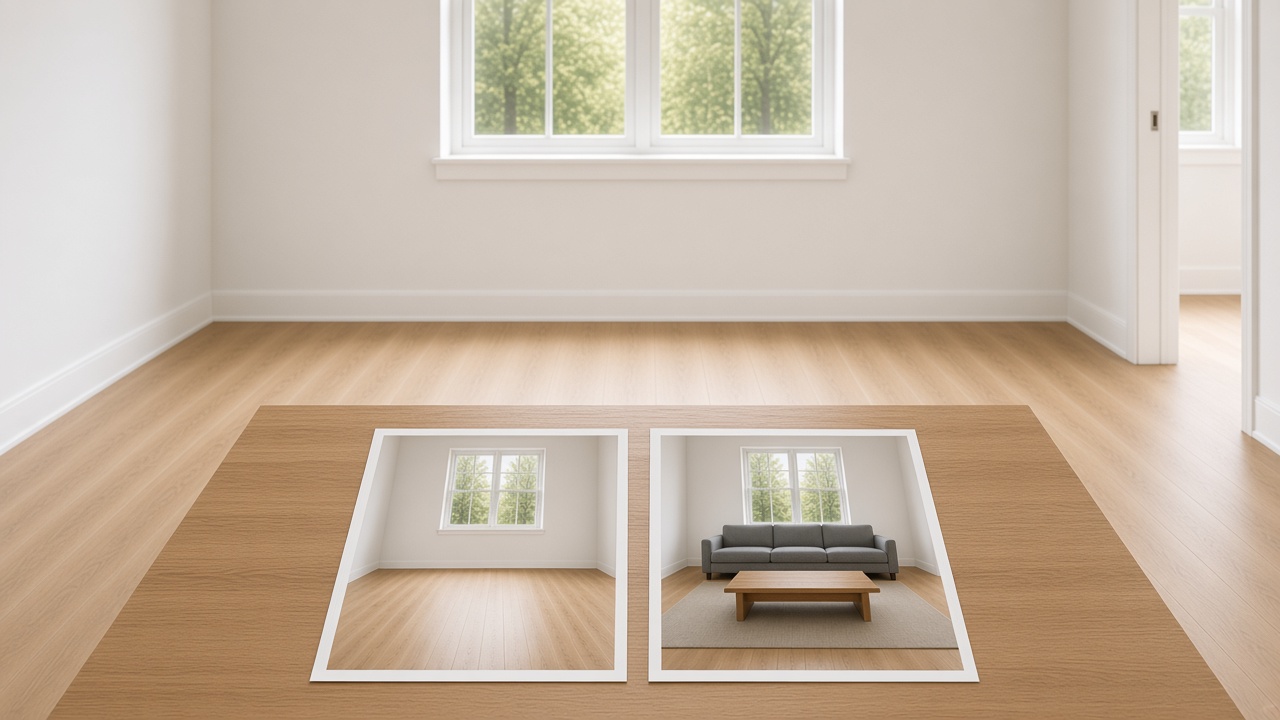
Keep the empty frame with the furnished one. The sofa is only in the print. The room it is lying in is still empty. Several MLSs, and California law, want the buyer to be able to see the unedited photo.
Virtual staging cost compared with a traditional staging invoice
NAR’s 2025 staging report gives the cleanest public number on the traditional side. The median cost of using a staging service was $1,500. When the listing agent staged the home themselves, the median was $500. That is a median across the agents who answered, for the staging job as they reported it. It is not a per-room rate, and it will not match every market or every house.
There is no matching NAR median for virtual staging cost. Studios publish their own menus, sometimes per photo and sometimes as a subscription, and those menus are not a national price. Compare a quote you can actually get with the $1,500 median, and count every room you intend to furnish. A cheap per-photo fee on twelve frames is a different invoice from one living room.
Also separate the staging bill from the photography bill. Virtual staging does not replace the shoot. It replaces the furniture, the second visit, and the reshoot of a room that was empty. If you still need twilight, a floor plan, or a 3D tour, those stay on the estimate.
Virtual staging software on this site is priced in credits, not as a $1,500 staging contract. A new account can start without a paid plan. The tool furnishes an empty photo and leaves the walls and windows in place. It does not remove furniture that is already in the room, and it does not print a disclosure on the file. You can try it on the virtual staging page. Plan details are on pricing.
When virtual staging is the better listing choice
Use virtual staging when the room is empty, the photos are already shot, and the listing needs a furnished gallery before the open house. One vacant room can be shown two ways, a living room and a home office, without renting two sets of furniture. That is the practical case virtual staging vs traditional staging keeps coming back to: the buyer’s first look is a photograph, and the photograph is all you are changing.
Keep the stager when people will walk through a furnished house and the impression in the room is the product. NAR’s own agents were not unanimous that virtual staging matters as much as the photos or the physical staging. If your seller expects the house to look like a television listing when the door opens, a file on the MLS will not do that job.
Whichever you choose, label the image the way your board requires before you publish.
Conclusion
Virtual staging cost is lower than a traditional staging service in the only national median NAR published for this decision: $1,500 for a staging service, $500 when the agent did the staging. The saving is real when you are furnishing a photo of an empty room. It disappears when the buyer needs the furniture to be in the house, or when the photo would have to invent architecture that is not there. For an empty room, furnish the photo on the virtual staging page, then set that result next to a staging quote.
Frequently asked questions
Is virtual staging cheaper than traditional staging?
Often, for an empty room, because the invoice does not include rented furniture or a second shoot. NAR’s 2025 median for a staging service is $1,500, or $500 if the agent staged the home. Virtual staging is priced by the vendor. Quote the number of rooms you will actually furnish.
Do MLS rules require a virtual staging disclosure?
Yes in practice, and the wording is local. NAR’s Code of Ethics Article 12 requires a true picture in advertising. Standard of Practice 12-10 extends that duty to images and bars misleading ones. It does not prescribe one national watermark. Some MLSs want the words on the photo, some want them in the remarks, and some want the original empty photo beside the staged frame. NAR has also described a California law, effective January 1, 2026, that requires disclosure of digitally altered listing images and access to the original. Check the MLS you upload to. This site does not burn that label into the image for you.
When is traditional home staging still worth the invoice?
When buyers will stand in the room and the furniture needs to be real: an occupied house, an open house, or a seller paying for the in-person impression. A furnished file is a gallery tool. It does not replace the house.
Sources
- National Association of Realtors, 2025 Profile of Home Staging, press release, May 6, 2025. Survey of 1,266 Realtors in February 2025. Margin of error ±2.75% at 95% confidence.
- National Association of Realtors, 2025 Profile of Home Buyers and Sellers, highlights.
- National Association of Realtors, Code of Ethics, Standards of Practice, Article 12 and Standard of Practice 12-10.
- National Association of Realtors, When Does Enhancing Listing Photos Go Too Far?, including the description of California’s digitally altered image rule effective January 1, 2026.